New Features & Capabilities
In this post, we’ll walk through how the latest release 25.2 enhances the automation capabilities with AI, RAB, and seamless project management.
Oracle Integration as an automation platform
Oracle Integration is evolving into a unified business automation platform , bridging systems, data, people, and AI.
With Oracle Integration, you can:
- Automate data flows between applications and services
- Use RPA robots to interact with systems that lack APIs
- Orchestrate AI-powered processes like document extraction and intelligent decision-making
Whether the apps are in Oracle Cloud, third-party SaaS, or on-premise, Oracle’s rich library of over 110+ adapters ensures smooth connectivity.
What’s New in Release 25.2?
Some highlights (I’ll dive deeper into each below)
- Support for private and managed endpoints
- RPA now included in the Enterprise Edition
- Up to 184 days of OIC log retention
- Support for 100MB payloads (structured data, cloud endpoints)
- Dynamic FTP connections at runtime
- AI-powered integration flow descriptions
- New capabilities within Projects feature
- Rapid Adapter Builder: Code-Free Adapter Development
- Pre-built Integration Solutions: Recipes & Accelerators
- New parallel action branche
- Healthcare Edition extension
- Disaster Recovery
- Event-Driven Integrations
Projects: Structure, Deploy, and Monitor
The new Projects feature is a game changer in this release 25.2. Think of a project as a container that helps you:
- Design integrations, connections, lookups, events
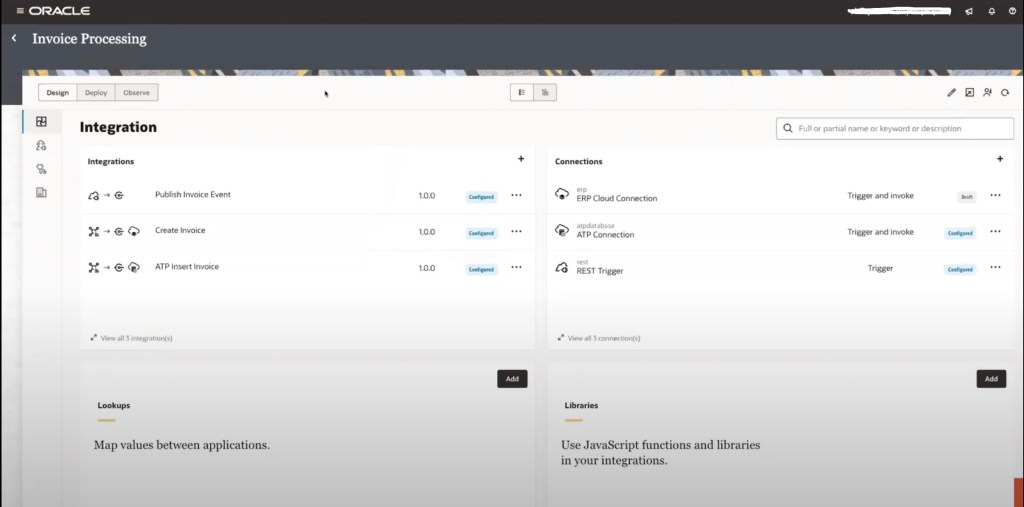
- Deploy grouped integrations and RPA bots as a package
- Observe and monitor everything from a single workspace
Key features include:
- Role-based access control (RBAC)
- Shared resources and dependencies view
- Integrated lifecycle management
You can even track and monitor individual instances, view activity streams, and manage access for ERP , HCM and others teams.
Also projects now support event-based flows, allowing you to:
- Create, publish, and subscribe to events
- Share events across multiple projects
- Filter data based on criteria ( orders from Ireland for example)
This model introduces true producer-consumer logic, improving decoupling and scalability.
Also you can now group related integrations into projects and deploy them as a unit.
With the new feature « Dependency diagram’, you visualize:
- Integration flows
- Connections
- Project summaries
The new dependency diagram visually maps how events, integrations, decisions, RPA flows, and connections relate within a project. This helps teams understand system behavior at a glance and streamlines onboarding.
Additionally, connections can now be shared across projects, improving reuse and security while minimizing redundant configuration.
With this feature, all integrations, decisions, events, shared connections lives inside the Projects framework.
This approach turns Projects into your unified hub for building, managing, and monitoring automation components.
From dependency diagrams to shared resources and integrated observability, Projects provide structure and clarity as your automation landscape scales.
Projects are becoming the one-stop shop for building end-to-end automation solutions.
By unifying decisions, integrations, RPA flows, event handling, and shared components in a single workspace, Oracle is simplifying how organizations design and scale digital processes.
Rapid Adapter Builder: Code-Free Adapter Development
No adapter? No problem. With the Rapid Adapter Builder, you can:
- Use Postman collections to define your APIs
- Automatically generate an adapter from your collection
- Add security policies and register it for reuse
This no-code feature accelerates custom adapter development, even when an official Oracle adapter isn’t available, it saves time and ensures reusability across teams and projects..
The UI of custom adapters built using the Rapid Adapter Builder are identical to Oracle’s pre-built adapters.
Available as a Visual Studio Code extension, this tool allows you to generate adapter code, build and test it locally, and seamlessly publish it to your OIC environment.
Whether you’re dealing with niche APIs or custom applications, this extension empowers developers to quickly craft reusable, enterprise-grade adapters.
Pre-built Integration Solutions: Recipes & Accelerators
Oracle provides a rich library of pre-built integrations in the form of:
- Recipes: Ideal for quick-starts, these are simple use cases designed to solve common challenges.
- Accelerators: Complete, end-to-end solutions that address comprehensive business processes.
With these, up to 80% of your integration work can be pre-packaged, leaving only 20% for customization.
Solutions can be installed directly from the Oracle Integration Store and you can even publish your own to the Marketplace.
OCI Private Endpoints: Secure Cloud-to-On-Prem Access
Oracle now supports private endpoints natively in OIC3.
No more managing connectivity agents or on-prem VMs. These endpoints enable secure, private communication to on-prem or VCN-protected resources without public internet exposure.
Key benefits:
- No per-hour or per-byte charges
- Direct access to 25+ OCI services (like Object Storage, Streaming, Anomaly Detection)
- Ability to configure custom hostnames for runtime integrations
Note. Like mentioned , by enabling private endpoints, you can eliminate the need for a connectivity agent, streamlining internal system access.
Parallel Flows: Accelerate Time-Consuming Tasks
With parallel action branches, you can execute multiple actions simultaneously, such as querying HCM and finance systems concurrently. This reduces integration run time and is especially useful for long-running processes.
Healthcare Edition: Industry-Specific Enhancements
The OIC Healthcare Edition extends the platform with:
- HL7 message support
- FHIR adapter
- Medical logic processing actions
- Enhanced data retention
Perfect for providers integrating clinical and business workflows on a unified platform.
Disaster Recovery: Active-Passive Made Simple
Oracle now offers managed disaster recovery for OIC, supporting:
- Active-passive regional setup (e.g., Ashburn & Phoenix)
- Bi-directional failover with automatic data synchronization
- Zero DNS management needed
- Support for integration, Visual Builder, agent, and file server components
(Note: Process, Insight, and B2B are not yet supported.)
Native OCI Actions: Code-Free Connectivity
Developers can now use native OCI actions to interact with services like:
- Object Storage
- Functions
- File Server
- Autonomous Database (ADW)
Event-Driven Integrations: Publish & Subscribe in Action
Events in OIC allow you to broadcast data changes (example. new purchase orders) to multiple subscribers:
- ADW
- File servers
- Other integrations
This architecture is essential for scalable, decoupled systems that need real-time responsiveness.
Interested in testing it out?
You can access Oracle Integration through the free tier by visiting cloud.oracle.com/free.
During sign-up, it’s crucial to select « India South » or « UK South » as your home region, as Oracle Integration instances are only provisioned in those regions on the free tier.
Once registered and email verified, you’re ready to use your own instance for labs and training.
Thanks for reading!
 Sanae BEKKAR - My Blog -
Laisser un commentaire