During this article, I will share the main deployment patterns based on specific criterias and scenarios that I will list below .
We define 4 main patterns that describe where you can deploy the connectivity agent , and how the connectivity flow is established between Oracle Integration instance and the connectivity agent in the context on an hybrid integration : customer On-Prem Network <> Oracle Integration <> SaaS solution.
Let’s get started !
Pattern . 1 . The on-premise app’s traffic can be send to a public internet.
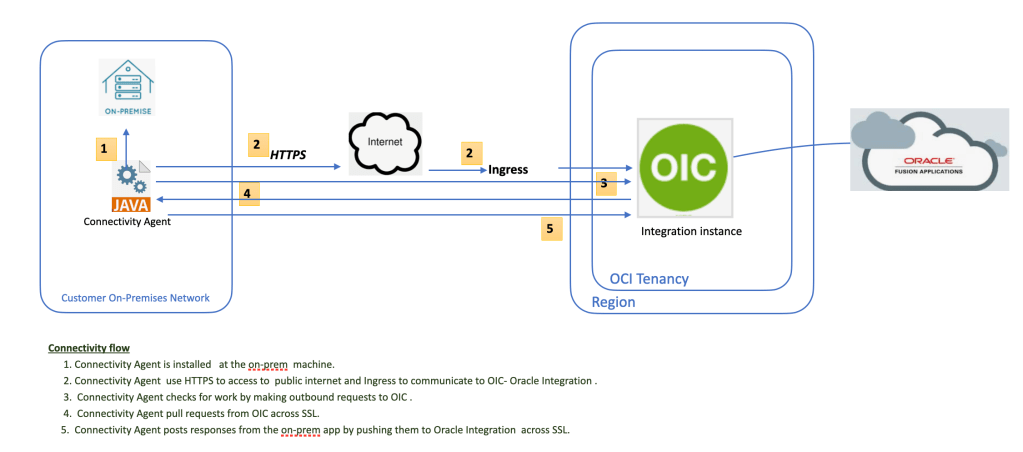
Pattern .2. The on-premise’s traffic must avoid to be send to a public internet.

Pattern .3. Connecting OIC with Customer on-prem network using Fast Connect + Public Peering .

Pattern .4. Connecting OIC instance with customer on-prem network using Fast Connect + Private Peering.
When we use a Private Peering , that means : from OCI , we can see all the private IP addresses from OCI including the on-premises’s IP addresses. Also, you need to configure a Customer VCN and grab access to all service or just OIC through the service gateway.
For this pattern , we define 2 different locations where the connectivity agent can be:
Option 1. Connectivity Agent is deployed directly in customer on-premise network .

Option 2. Connectivity Agent is deployed in a private subnet within OCI.
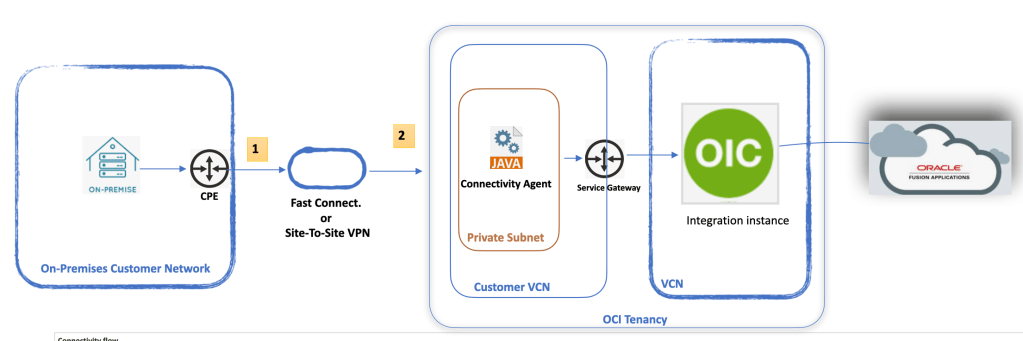
For this option m the only condition is : The connectivity Agent need to be able to route messages to the on-premise app on private IP address.
Thanks for reading !
 Sanae BEKKAR - My Blog -
Laisser un commentaire