A typical BPM initiative touches many systems and a variety of people in an organization.
Roles are used to articulate and manage participation of systems and people at different stages of the lifecycle of a BPM project.
BPMN modeling notation also uses the roles concept for the purpose of categorizing participants involved in a business process application.
Here we will mainly discuss the roles of people participating in the delivery of a BPM project. While there are no industry-wide standards for BPM roles yet, the following list is representative of popular practice:
Process sponsor : Process sponsor, typically a business person, is the initiator
of the project and provides the senior management connection to the project.
Often the sponsor also provides the funding for the project.
Process owner : Thi s is the role that leads and maintains the overall context of the BPM project. A process owner is familiar with, and influences the high-level characteristics of, the project and the process, goals and KPIs, process variabilities, and future change requirements.
He also has an oversight of the key milestones and deliverables. A « process context map »
that summarizes all the important aspects of the process is often a useful tool used by this role.
Program/project manager: Often, several related projects are grouped under a program, and hence the role of a program manager may be useful in addition to that of the project manager. The project management role is primarily responsible for creating the
Work Breakdown Structure ( WBS ) for the project, managing schedule, resource and deliverables, and coordination among other roles engaged in the project.
The program/project manager is also attentive to capability maturity of the project participants and risks involved in the project. The program/project manager uses executive reporting to keep process sponsor and process owner up-to-date on the
project status.
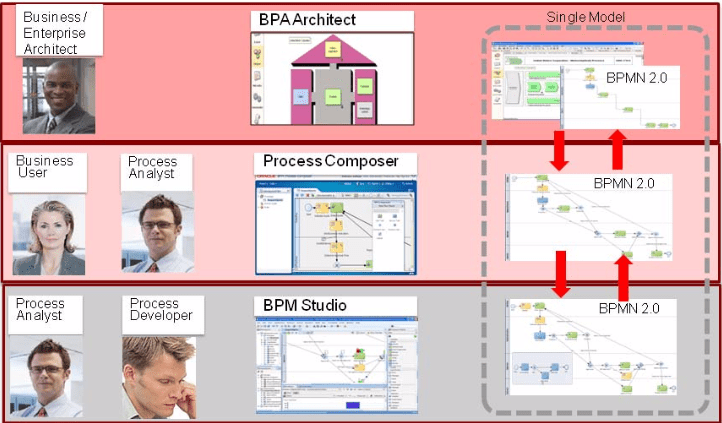
Enterprise architect/business analyst : Depending on the organization and the project scope, these may be separate roles. The focus here is to capture relevant business architecture, value chains, and strategy maps, and alignthe target process with them. The business analyst specifies all the business level requirements for the process for the
as-is and to-be states.
These roles own the use-case level documentation of the processes and also define the
process KPIs.
Business user : This role, sometimes included with in the business analyst role, is a key contributor to the business process discovery activities, and is tasked with continual review of the process model and making changes to business processes that are (relatively) small and not highly technical. In some cases, expert end users (that is, those who work with BPM applications to execute process based transactions) can play this role. One key benefit is to have the business users directly implement such process modifications without initiating new or additional IT involvement.
Process analyst/architect: This role pertains more to the actual implementation of the process. He may conduct process simulation and suggest incremental refinements. He also contributes to the definitions of the exceptions, and of business indicators and KPIs, and formulates mechanisms to collect necessary input and to compute such metrics. He also provides the necessary technical details required to create the actual process model.
In the event that the analyst and architect roles are handled by different individuals, the analyst focuses mainly on the business aspects.
Process designer/developer : This role is responsible for producing the digital rendition of the process model, encoding business rules, designing the user interfaces, and creating the executable version of the process.
Depending on the BPMS and the division of labor in an organization, an additional and
more technical role called the IT Developer may supplement this role and perform the tasks of creating and connecting process end-points, some of which can be software
services (as in SOA).
 Sanae BEKKAR - My Blog -
Laisser un commentaire